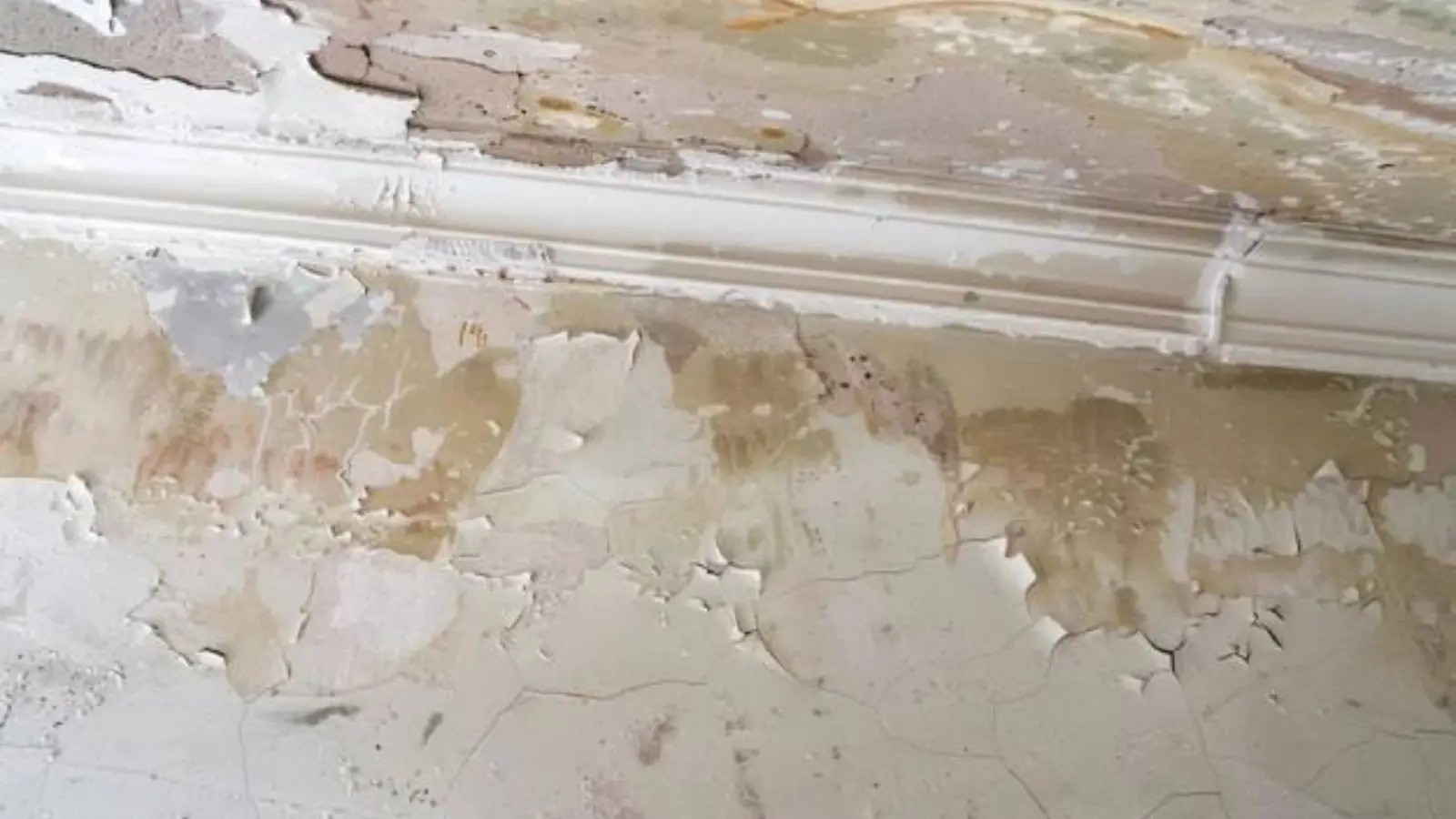
Water damage usually looks like brown or yellow stains, bubbling or peeling paint, soft or swollen drywall, warped floors and a musty smell. Some of it hides inside wall cavities, under flooring and above ceilings, so a dry surface does not mean a dry house. Restoration crews classify what they find using the ANSI/IICRC S500 standard, which is why moisture readings matter more than looks.
A simple rule helps. If you see a stain, press it. Soft means wet or recently wet. Call when a stain grows, a smell keeps coming back, or you find moisture you cannot trace.
Signs you can spot from the middle of a room
Start with ceilings, because gravity sends water down. A brown or tan ring, often with a darker edge, suggests water has come through from the roof or from plumbing above. Sagging, bubbling paint or a ceiling that looks slightly bowed means it is holding water right now.
Walls tell a similar story. Look for peeling paint, wallpaper seams that lift, stains that look like a map, and drywall that feels cool or soft. Fine white crust on brick or block can mean water has been moving through.
Floors, baseboards, cabinets and windows
Baseboards are the early warning system. They swell, split at the bottom and pull away from the wall when water wicks up from the floor. Laminate and hardwood cup, lift at the edges or open gaps. Vinyl may show dark spots or loose corners.
Check under sinks, where the cabinet floor can swell or stain from a slow supply or drain leak. Look at window sills for dark staining and rotting paint. Those usually point to a failed seal, flashing or condensation.
| Sign | What it suggests | Urgency |
|---|---|---|
| Brown ring on a ceiling | Roof or upstairs plumbing leak, maybe a repeat | High if damp or growing. |
| Bubbling or peeling paint | Moisture behind the surface | Medium, check within days. |
| Soft or crumbly drywall | Long or heavy wetting | High. |
| Swollen baseboard | Water at floor level from an appliance, a slab seep or flooding | High. |
| Cupped or lifted flooring | Moisture on or under the boards | High. |
| Swollen cabinet floor under a sink | Slow supply or drain leak | Medium to high. |
| Musty smell, no visible stain | Damp material you cannot see | Medium, find the source. |
| Dark staining at window sills | Failed seal, flashing or condensation | Low to medium. |
Urgency rises when the spot is still wet, growing or near electrical outlets.
Smell and sound: the hidden clues
A musty or earthy smell with no stain is one of the most common hidden signs. It often comes from wet insulation, wet carpet pad or a wall cavity that never dried. Mold needs moisture to grow, so a persistent smell is a reason to find the source, not just to mask it.
Listen too. A faint drip inside a wall at night, a toilet that refills by itself, or a meter that keeps moving when every fixture is off all point to a leak. A plumber finds and fixes a pipe leak. Restoration crews dry out what the leak soaked.
Not sure what you are looking at?
Send a photo or call us at (972) 945-2885. We answer 24/7 and can often respond the same day.
Check it yourself with a flashlight and a paper test
Light it sideways
In a dim room, hold a flashlight flat against the wall or ceiling so ripples, bulges and stain edges stand out.
Press the spot
Push a thumb or a screwdriver tip into the stain, and note whether it feels soft, crumbly or cool.
Tape on dry paper
Tape a square of dry paper towel over the area, seal the edges and check it after a day for dampness.
Look nearby
Check the room above, the wall behind and the cabinet below, since water moves away from where it enters.
The paper test is simple and rough. A damp square means moisture is still reaching the surface. A dry one does not clear the wall, because only a moisture meter or thermal imaging camera can read behind it.
Grand Prairie creeks and what flooding leaves behind
Grand Prairie's city floodplain plan says about 36 percent of city land is in the floodplain. It names Johnson, Mountain, Cottonwood and Fish Creeks and the West Fork Trinity River, and it lists a 2015 flood as the largest event in the plan. If you live near one of those creeks, a flood check should be part of your walk-through. Our crews also serve homes via our Grand Prairie restoration page.
After creek flooding, look for tide lines on walls, swollen baseboards and a musty smell. A tide line shows the high-water mark, and anything below it, including drywall and insulation, is suspect. Flood water is usually contaminated, and homeowners policies generally do not cover flood, so photograph everything and check your policy.
Quick check for a room you suspect
- Stains with a ring or a darker edge.
- Paint that bubbles, flakes or peels.
- Baseboards that swell or pull from the wall.
- Floors that cup, lift or sound hollow.
- Cabinet floors that soften or stain.
- A musty smell that comes and goes.
- A water meter that moves with everything off.
When to call and who to call
Call right away if water is active, ceilings sag, outlets are wet or the damp spot is bigger than a dinner plate. Stop the source first, and shut off the main valve if you can. Turn off power only if the area is dry and safe, and call the utility or 911 first for sparks, gas or deep water.
For hidden or confirmed wet materials, water damage cleanup covers extraction and drying. If the wall stays wet beyond two days, water mitigation with meters and dehumidifiers is the safer call. We also work with homeowners in Cedar Hill.
Frequently Asked Questions
Often it is a smell, a stain or a baseboard that starts to swell. Many people notice a musty odor before they see anything. Treat it as a reason to look, press and check with a moisture reading.
Yes. Water can run down inside a wall cavity or collect under flooring while the surface stays dry. A moisture meter or thermal imaging camera can find it without cutting into the wall first.
It can be an old leak that stopped, or one that comes and goes with rain or use. Mark the edge with a pencil and watch it. If it grows, press it and call.
Duncanville names no flood zones on its city pages, so check the FEMA Flood Map Service Center for your address. Grand Prairie's plan puts about 36 percent of its land in the floodplain, which shows why a map check is worth doing in this part of North Texas. If you ever do see a tide line, treat it as flood water.
No. It can come from damp carpet, wet insulation or a drain. It does mean something is staying wet, so find the moisture. Health questions belong with a physician.