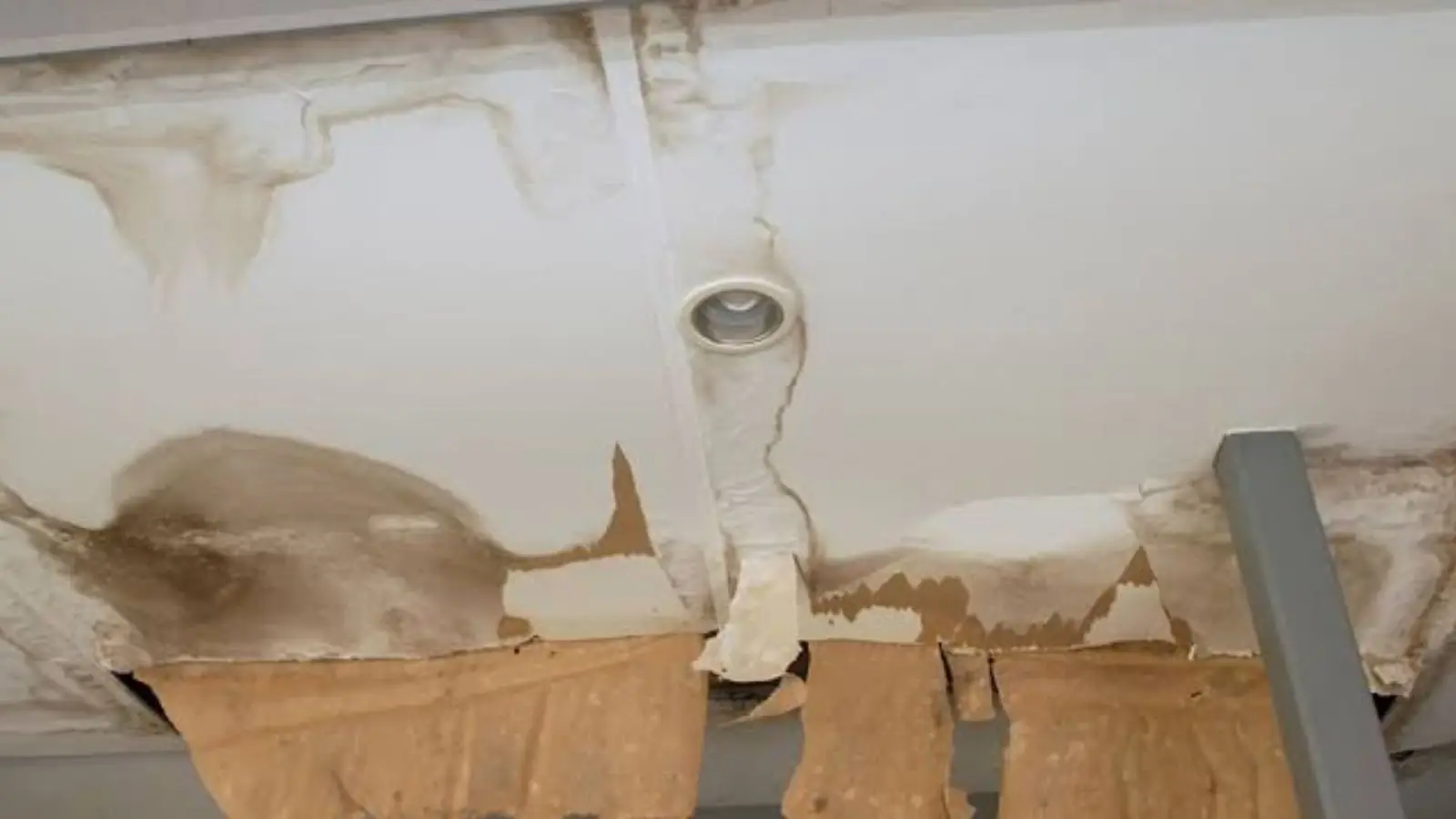
The fix follows one order: stop the source, make the area safe, dry everything that is wet, remove what cannot dry, then rebuild. Skipping ahead to paint is the most common mistake. A ceiling stain painted over while the drywall is still damp comes back, and the damp material can grow mold. For a bulging or sagging ceiling, call before you touch it.
First, stop the source and check for danger
Find where the water is coming from. A plumbing leak means shutting off the main water valve. A roof leak means a tarp or a roofer, and an overflowing tub or washer upstairs means turning the water off at that fixture.
Look for a sag, a bulge or water pooling in the drywall. Water adds a lot of weight, and a bowed ceiling can drop. Keep people and pets out from under it. Keep power off to fixtures in the wet area unless you know it is safe and dry. If you smell gas or see sparks, leave and call the utility or 911 first.
Wiring and recessed lights above a wet ceiling are a hazard. Do not poke at a bulge with your hands. A small hole made from a safe angle lets the water drain into a bucket, but only if no electrical device is in that spot.
Which symptom points to which problem
| Ceiling symptom | Likely cause | Who to call |
|---|---|---|
| Brown ring that grows after rain | Roof leak or flashing failure | Roofer, then restoration. |
| Stain under a bathroom or laundry | Supply line, drain or shower pan leak | Plumber, then restoration. |
| Drip or bulge after a pipe burst | Supply line failure above | Plumber and water mitigation crew. |
| Damp spots near a vent or air handler | Condensation or clogged condensate drain | HVAC technician. |
| Sagging drywall holding water | Large volume of trapped water | Emergency water crew now. |
A stain alone does not tell you the source. Moisture readings and a thermal imaging camera help pin it down.
Use the table as a starting guess, not a diagnosis. A ring that grows only after rain points up at the roof, while a stain that grows on dry days points at plumbing or a cooling system. Write down when the stain changes, and take dated photos. That record helps a roofer, a plumber and your insurer.
Drying comes before any repair
Ceiling wet or sagging right now?
Call (972) 945-2885 for the 24/7 emergency line. Same-day response is available when crews are free.
Drying is the part you cannot rush. Moisture meters show how far dampness runs, and a thermal imaging camera finds wet insulation you cannot see. Air movers and an LGR dehumidifier then pull moisture out of the space, and a drying log records the readings each day.
If the drywall stays wet past two days, water mitigation is the safer call, because wet cavities grow mold and rot fasteners if they sit. Industry practice follows ANSI/IICRC S500, and you can ask any company whether its crews work to it.
Cutting out wet drywall and insulation
Drywall that is soft, stained in rings, sagging or still wet after drying must go. Cut a clean rectangle out to the nearest joist so the patch has something to screw into. Remove wet insulation above it, since insulation holds water like a sponge.
Wear eye protection and a dust mask, and bag the debris. If the water came from a dirty source, such as a backed-up drain, keep it out of the living space and have a crew handle it.
Stop the source
Shut off the water or tarp the roof, and make the area safe.
Dry the space
Run air movers and a dehumidifier until readings are normal.
Cut out wet material
Remove soft drywall and wet insulation back to dry framing.
Patch and finish
Hang new drywall, tape, texture, prime and paint.
Patching, texture and primer
Once the framing reads dry, hang a new piece of drywall, tape the seams and apply joint compound in thin coats, sanding between them. Match the old texture, whether it is knockdown, orange peel or popcorn, with a spray can or a hopper gun.
Prime the whole patch with a stain-blocking primer, then paint the full ceiling plane from wall to wall so the new area does not flash. Ask Permit & Inspection Services at (972) 780-5000 whether your repair needs a permit, since the city says repair work generally does.
When it is a roofer or plumber job
Restoration crews dry and rebuild. We do not replace roofers, plumbers or HVAC technicians. If the leak is in the roof, flashing or a pipe, that trade fixes it, and then water damage repair puts the ceiling back.
Cost depends on the water category, the size of the area, the materials, how many drying days are needed and how much rebuild is involved. The real number comes from an on-site look.
Duncanville roofs and ceilings after storms
The National Weather Service says thunderstorm and severe weather frequency peaks in spring across the region, and large hail and damaging winds occur nearly every year. A roof can lose shingles or crack flashing without any dripping on the day of the storm.
So inspect the roof from the ground and walk your ceilings after each strong storm. Look for new rings, bulges or damp insulation in the attic. Catching a small leak in days, not months, is the difference between a patch and a full section of drywall.
We also cover neighbors in Cedar Hill and Grand Prairie, where the same storm systems roll through.
Frequently Asked Questions
Only if it is safe and you must relieve the weight. Poke a small hole from the side with a bucket underneath, and stay clear of lights or wiring. If the bulge is large, call a crew instead.
A stain-blocking primer can cover a dry, old stain. It will not fix a ceiling that is still wet, and the stain will come back. Confirm the source is fixed and the material is dry first.
A thermal imaging camera and a moisture meter show it quickly. At home, look from the attic for dark, matted or heavy insulation. Wet insulation should come out.
Call a roofer to check the roof and then call us at (972) 945-2885 for the ceiling. Because large hail and damaging winds hit the region nearly every year, it helps to have both a roof inspection and a moisture check after a big storm.
Sudden and accidental damage is often covered, and gradual leaks and neglect often are not. Check your policy and tell your agent as soon as you find damage. The Texas Department of Insurance help line is 1-800-252-3439.